Manufacturers are under constant pressure to increase productivity, improve product quality and reduce operational costs. BINARIS develops industrial AI, computer vision and engineering software that transform production environments into intelligent, connected and data-driven manufacturing operations.
Factory floors are generating more data than ever — from sensors, vision systems, ERP platforms and production equipment — but most of it goes unanalysed. At the same time, skilled labour is harder to find, supply chains are increasingly volatile and customer tolerance for quality failures is near zero. Manufacturers who continue to rely on manual inspection, reactive maintenance and intuition-based scheduling are falling behind. The gap between those who use their operational data intelligently and those who don't is widening every year.
Manual inspection is slow, inconsistent and unable to scale with production volumes.
Unexpected equipment failures disrupt production and drive up maintenance costs.
Bottlenecks, variable processes and inefficient scheduling limit production capacity.
A shrinking skilled workforce increases reliance on automation and intelligent tooling.
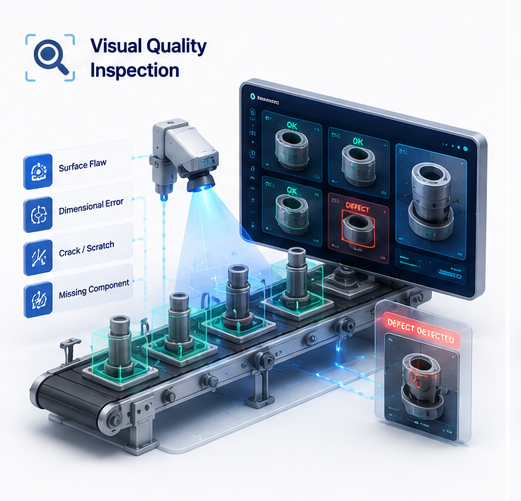
Real-time defect detection on the production line using computer vision.
ML models that monitor sensor data to flag equipment failure risk before it occurs.
AI-driven scheduling and resource allocation to maximise throughput and reduce waste.
Intelligent agents that automate repetitive tasks and integrate with ERP and MES systems.
Catch defects earlier to eliminate costly downstream rework and material waste.
Predict failures earlier to reduce unplanned downtime and improve asset availability.
Optimise line speed and capacity utilisation without increasing headcount.
Raise Overall Equipment Effectiveness across availability, performance and quality.
High-impact production challenges where intelligent automation creates immediate value.
Computer vision systems that detect defects, dimensional errors and surface flaws on the production line in real time.
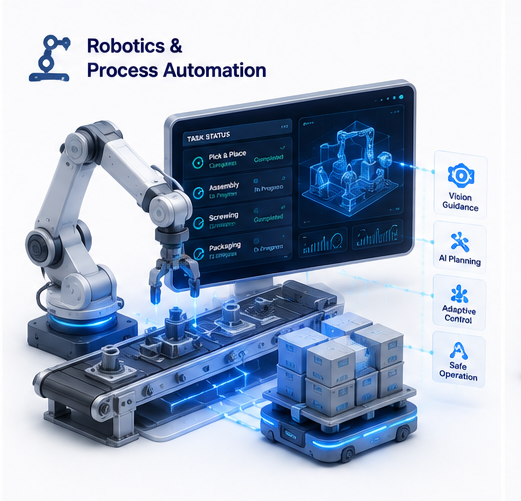
AI agents and vision-guided robotics that automate repetitive tasks and improve line throughput.
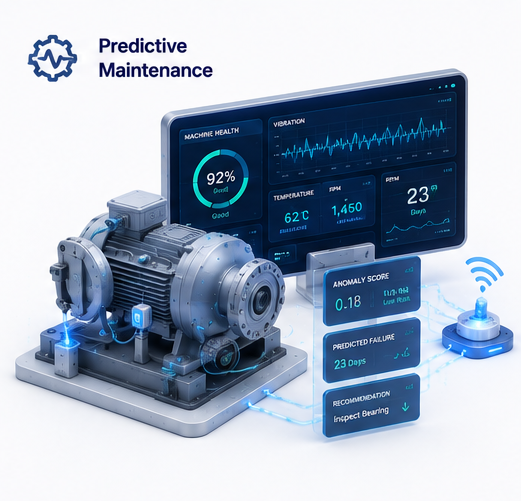
ML models that monitor equipment sensor data to predict failures before they cause unplanned downtime.
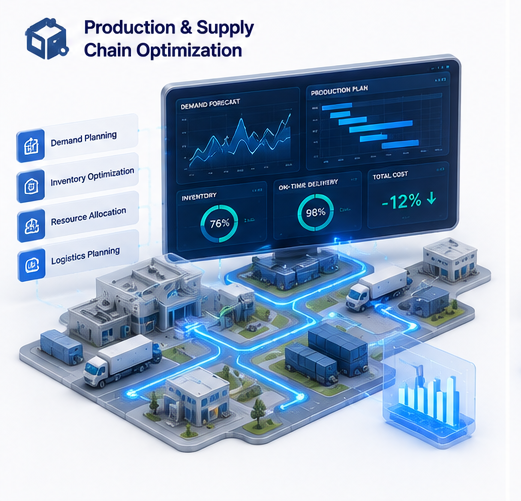
Predictive scheduling and resource allocation that reduce waste and bottlenecks across the supply chain.
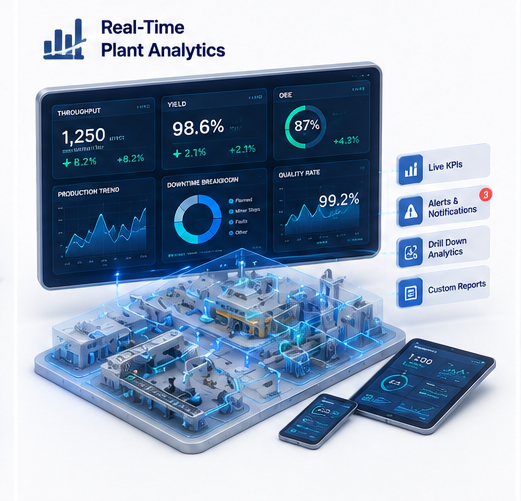
Live dashboards and KPI tracking that give plant managers visibility into throughput, yield and efficiency.
Tell us about your quality, automation or maintenance challenge — our team will get back to you within one business day.
Talk to Our Team